
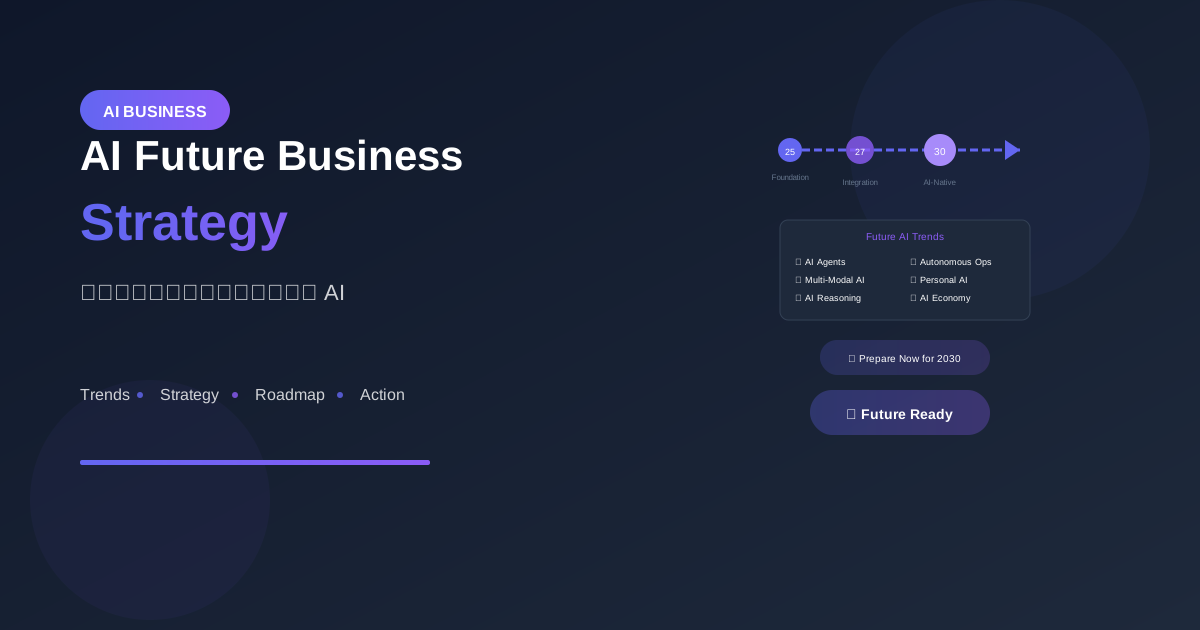
AI กำลังเปลี่ยนโลกธุรกิจอย่างรวดเร็ว องค์กรที่เตรียมพร้อมจะเป็นผู้นำ
AI Trends ที่กำลังมา
2025-2030 AI Predictions
AI Evolution Timeline:
┌─────────────────────────────────────────────────────────────┐
│                                                             │
│  2025: Foundation Year                                      │
│  ├─ AI agents become mainstream                             │
│  ├─ Multi-modal AI (text + image + audio + video)          │
│  ├─ Enterprise AI adoption accelerates                      │
│  └─ AI regulation frameworks emerge                         │
│                                                             │
│  2026-2027: Integration Era                                 │
│  ├─ AI embedded in all software                             │
│  ├─ Autonomous AI systems                                   │
│  ├─ Personal AI assistants become standard                  │
│  └─ Industry-specific AI solutions                          │
│                                                             │
│  2028-2030: Transformation Era                              │
│  ├─ AI-native businesses dominate                           │
│  ├─ Human-AI collaboration as norm                          │
│  ├─ New business models emerge                              │
│  └─ AI reshapes industries completely                       │
│                                                             │
└─────────────────────────────────────────────────────────────┘
Key Technology Trends
Emerging AI Capabilities:

1. AI Agents
   ├─ Autonomous task completion
   ├─ Multi-step reasoning
   ├─ Tool use and API calls
   └─ Planning and execution

2. Multi-Modal AI
   ├─ Understand images, audio, video
   ├─ Generate any media type
   ├─ Seamless mode switching
   └─ Richer interactions

3. Personalized AI
   ├─ Learn individual preferences
   ├─ Context-aware responses
   ├─ Long-term memory
   └─ Adaptive interfaces

4. Embodied AI
   ├─ Physical robots
   ├─ Autonomous vehicles
   ├─ Smart environments
   └─ Real-world interaction

5. AI Reasoning
   ├─ Complex problem solving
   ├─ Scientific discovery
   ├─ Strategic planning
   └─ Creative synthesis
Business Model Transformation
AI-Native Business Models
New Business Models Enabled by AI:

1. Hyper-Personalization at Scale
   ├─ Product: Unique for every customer
   ├─ Pricing: Individual optimization
   ├─ Service: Tailored experiences
   └─ Example: AI-designed products

2. Autonomous Services
   ├─ Self-running operations
   ├─ Minimal human intervention
   ├─ 24/7 availability
   └─ Example: AI consultants

3. AI-as-a-Service (AIaaS)
   ├─ Sell AI capabilities
   ├─ Outcome-based pricing
   ├─ Vertical AI solutions
   └─ Example: Industry AI platforms

4. Data-AI Ecosystems
   ├─ Data network effects
   ├─ AI improvement loops
   ├─ Platform economics
   └─ Example: AI marketplaces

5. Human-AI Partnerships
   ├─ Augmented professionals
   ├─ AI co-pilots
   ├─ Collaborative creation
   └─ Example: AI-enhanced consulting
Industry Disruption Map
Industries Most Impacted by AI:

High Impact, Near-term:
├─ Customer Service → AI handles 80%+
├─ Content/Media → AI creates majority
├─ Finance → AI-driven decisions
├─ Healthcare → AI diagnosis standard
└─ Education → Personalized AI tutoring

High Impact, Medium-term:
├─ Legal → AI legal assistants
├─ Real Estate → AI valuation/matching
├─ Manufacturing → Lights-out factories
├─ Retail → AI-optimized everything
└─ Agriculture → Autonomous farming

Emerging Transformation:
├─ Construction → AI design/planning
├─ Energy → AI grid management
├─ Transportation → Autonomous systems
├─ Government → AI public services
└─ R&D → AI-accelerated discovery
Workforce Evolution
Future of Work with AI
Work Transformation:
┌─────────────────────────────────────────────────────────────┐
│                                                             │
│  Jobs Automated:                                            │
│  ├─ Routine cognitive tasks                                 │
│  ├─ Data entry and processing                               │
│  ├─ Basic customer service                                  │
│  └─ Standard report generation                              │
│                                                             │
│  Jobs Augmented:                                            │
│  ├─ Knowledge workers + AI assistants                       │
│  ├─ Professionals + AI tools                                │
│  ├─ Managers + AI analytics                                 │
│  └─ Creatives + AI collaboration                            │
│                                                             │
│  New Jobs Created:                                          │
│  ├─ AI trainers and ethicists                               │
│  ├─ Human-AI collaboration designers                        │
│  ├─ AI product managers                                     │
│  └─ Domain-AI specialists                                   │
│                                                             │
│  Workforce Strategy:                                        │
│  ├─ Continuous learning culture                             │
│  ├─ AI literacy as requirement                              │
│  ├─ Human skills premium                                    │
│  └─ Flexible work models                                    │
│                                                             │
└─────────────────────────────────────────────────────────────┘
Skills for AI Era
Future-Proof Skills:

Technical:
├─ AI tool proficiency
├─ Data literacy
├─ Prompt engineering
├─ AI workflow design
└─ Basic coding/automation

Human-Centric:
├─ Critical thinking
├─ Complex problem solving
├─ Creativity and innovation
├─ Emotional intelligence
├─ Leadership and collaboration

Business:
├─ AI strategy
├─ Digital transformation
├─ Change management
├─ Ethics and governance
└─ Cross-functional leadership
Strategic Planning for AI Future
Building AI-Ready Organization
class AIReadyOrganization:
    def __init__(self):
        self.pillars = {
            "strategy": self._build_ai_strategy(),
            "culture": self._build_ai_culture(),
            "capabilities": self._build_ai_capabilities(),
            "infrastructure": self._build_ai_infrastructure(),
            "governance": self._build_ai_governance()
        }

    def _build_ai_strategy(self):
        return {
            "vision": "AI-native organization by 2030",
            "priorities": [
                "Customer experience transformation",
                "Operational excellence",
                "Product innovation",
                "Workforce augmentation"
            ],
            "investment_plan": "10% of revenue to AI initiatives",
            "success_metrics": "50% operations AI-enabled by 2027"
        }

    def _build_ai_culture(self):
        return {
            "values": ["Innovation", "Experimentation", "Learning"],
            "initiatives": [
                "AI literacy for all",
                "Innovation labs",
                "Fail-fast culture",
                "Cross-functional AI teams"
            ]
        }

    def _build_ai_capabilities(self):
        return {
            "talent": "Hire AI specialists + upskill existing",
            "partnerships": "Strategic AI vendors + academia",
            "centers_of_excellence": "AI CoE established",
            "communities": "AI champions network"
        }
Strategic Scenarios
Scenario Planning for AI:

Scenario 1: AI Acceleration
─────────────────────────────
Assumption: AI advances faster than expected
├─ Impact: Rapid disruption
├─ Winners: Early AI adopters
├─ Strategy: Aggressive AI investment
└─ Risk: Falling behind quickly

Scenario 2: Gradual AI Integration
─────────────────────────────
Assumption: Steady AI progress
├─ Impact: Manageable transformation
├─ Winners: Strategic adopters
├─ Strategy: Balanced AI investment
└─ Risk: Under-investing

Scenario 3: AI Regulation Heavy
─────────────────────────────
Assumption: Strong AI regulations emerge
├─ Impact: Slower commercial adoption
├─ Winners: Compliance-ready companies
├─ Strategy: Ethics-first AI approach
└─ Risk: Over-regulation costs

Scenario 4: AI Commoditization
─────────────────────────────
Assumption: AI becomes commodity
├─ Impact: No AI advantage possible
├─ Winners: Best implementers
├─ Strategy: Focus on execution
└─ Risk: AI investment wasted
Implementation Roadmap
5-Year AI Transformation Plan
Year 1: Foundation
Q1-Q2:
├─ AI strategy development
├─ Use case identification
├─ Pilot projects initiated
└─ AI governance established

Q3-Q4:
├─ Successful pilots scaled
├─ AI talent acquisition
├─ Training programs launched
└─ Infrastructure investments

Year 2: Acceleration
├─ AI embedded in core processes
├─ Customer-facing AI launched
├─ Center of excellence mature
├─ Measurable ROI achieved
└─ Expanded use cases

Year 3: Integration
├─ AI-first culture established
├─ Most processes AI-enabled
├─ New AI products/services
├─ Data-driven organization
└─ Industry leadership position

Year 4-5: Leadership
├─ AI innovation hub
├─ Industry benchmark
├─ AI-native operations
├─ New business models
└─ Sustainable AI advantage
Investment Framework
AI Investment Allocation:

Year 1-2 (Foundation):
┌─────────────────────────────────────┐
│ Infrastructure: 30%                 │
│ ├─ Cloud/compute                    │
│ ├─ Data platforms                   │
│ └─ Security                         │
│                                     │
│ People: 35%                         │
│ ├─ Hiring                           │
│ ├─ Training                         │
│ └─ Change management                │
│                                     │
│ Technology: 25%                     │
│ ├─ AI tools/platforms               │
│ ├─ Integration                      │
│ └─ Custom development               │
│                                     │
│ Innovation: 10%                     │
│ ├─ R&D                              │
│ ├─ Experiments                      │
│ └─ External partnerships            │
└─────────────────────────────────────┘

Year 3-5 (Scale):
Infrastructure: 15%
People: 25%
Technology: 35%
Innovation: 25%
Risk Management
AI Future Risks
Strategic Risks to Monitor:

Technology Risks:
├─ AI capability plateau
├─ Vendor dependency
├─ Technology obsolescence
└─ Integration complexity

Business Risks:
├─ Competitor leapfrog
├─ Business model disruption
├─ Talent war losses
└─ Investment waste

Regulatory Risks:
├─ New AI regulations
├─ Data privacy laws
├─ Industry-specific rules
└─ Cross-border compliance

Operational Risks:
├─ AI system failures
├─ Security breaches
├─ Skill gaps
└─ Change resistance
Mitigation Strategies
Risk Mitigation Framework:

1. Technology Risks
   ├─ Multi-vendor strategy
   ├─ Modular architecture
   ├─ Continuous monitoring
   └─ Regular technology review

2. Business Risks
   ├─ Scenario planning
   ├─ Agile strategy
   ├─ Diversified AI portfolio
   └─ Strong talent pipeline

3. Regulatory Risks
   ├─ Ethics-first approach
   ├─ Regulatory monitoring
   ├─ Compliance by design
   └─ Industry engagement

4. Operational Risks
   ├─ Robust governance
   ├─ Continuous training
   ├─ Change management
   └─ Incident response plans
Action Items for Leaders
CEO Checklist
AI Leadership Actions:

Immediate (0-30 days):
□ Assess current AI maturity
□ Benchmark vs competitors
□ Identify quick wins
□ Assign AI champion

Short-term (1-6 months):
□ Develop AI vision/strategy
□ Allocate AI budget
□ Launch pilot projects
□ Start AI education

Medium-term (6-18 months):
□ Scale successful pilots
□ Build AI team/capabilities
□ Integrate AI into operations
□ Measure and communicate ROI

Long-term (18+ months):
□ Transform business model
□ Lead industry AI adoption
□ Develop AI innovations
□ Build sustainable advantage
Board-Level Questions
Questions Boards Should Ask:

Strategy:
• What is our AI strategy?
• How does AI fit our overall strategy?
• What's our AI competitive position?

Investment:
• How much are we investing in AI?
• What's the expected ROI?
• How does this compare to competitors?

Risk:
• What are our AI risks?
• How are we managing them?
• What's our AI governance?

Talent:
• Do we have AI talent?
• What's our upskilling plan?
• How do we attract AI talent?

Ethics:
• What's our AI ethics framework?
• How do we ensure responsible AI?
• Are we prepared for AI regulations?
สรุป
AI Future Outlook:
-
AI จะเปลี่ยนทุกอุตสาหกรรม
- ไม่มีธุรกิจที่ไม่ได้รับผลกระทบ
- เร็วกว่าที่คาดไว้
-
Business Model จะเปลี่ยน
- AI-native models
- Hyper-personalization
- Autonomous operations
-
Workforce จะ Transform
- Human-AI collaboration
- New skills required
- New jobs created
-
Early Movers Win
- AI advantage compounds
- Late adopters struggle
- Start now
Strategic Imperatives:
- Develop clear AI strategy
- Invest in capabilities
- Build AI culture
- Manage risks
- Execute relentlessly
The Future Belongs to AI-Ready Organizations
อ่านเพิ่มเติม:
เขียนโดย
AI Unlocked Team
สถาบันสอน AI และ Vibe Coding — เชียงใหม่และออนไลน์
AI Unlocked สอน AI และ Vibe Coding มากว่า 15 ปี ผู้เรียนกว่า 1,500 คน โฟกัสลงมือทำจริงด้วย Claude Code, n8n และ AI Agent
บทความในหัวข้อเดียวกัน
เรียน AI 2026 — Complete Roadmap จากศูนย์ถึงโปร
เรียน AI ปี 2026 ไม่รู้จะเริ่มต้นยังไง? อ่าน Roadmap ฉบับสมบูรณ์นี้ ครบทุก Stage พร้อม Track ตามอาชีพ เริ่มได้เลยวันนี้

เรียน AI ใน 30 วัน — Plan สำหรับคนงานยุ่ง
เรียน AI 30 วัน ได้จริงไหม? Plan วันละ 1 ชม. สำหรับคนทำงานยุ่ง ตั้งแต่ Foundation ถึง Portfolio — เริ่มต้นได้เลยวันนี้ ดู Pricing
เรียน AI แล้วเปลี่ยนสายงานได้จริงไหม — Real Case Thai
เรียน AI เปลี่ยนสายงานได้จริงในไทยปี 2026 — 4 case จริง timeline realistic และขั้นตอนที่ทำได้เลย เริ่มต้นที่ AI Unlocked