
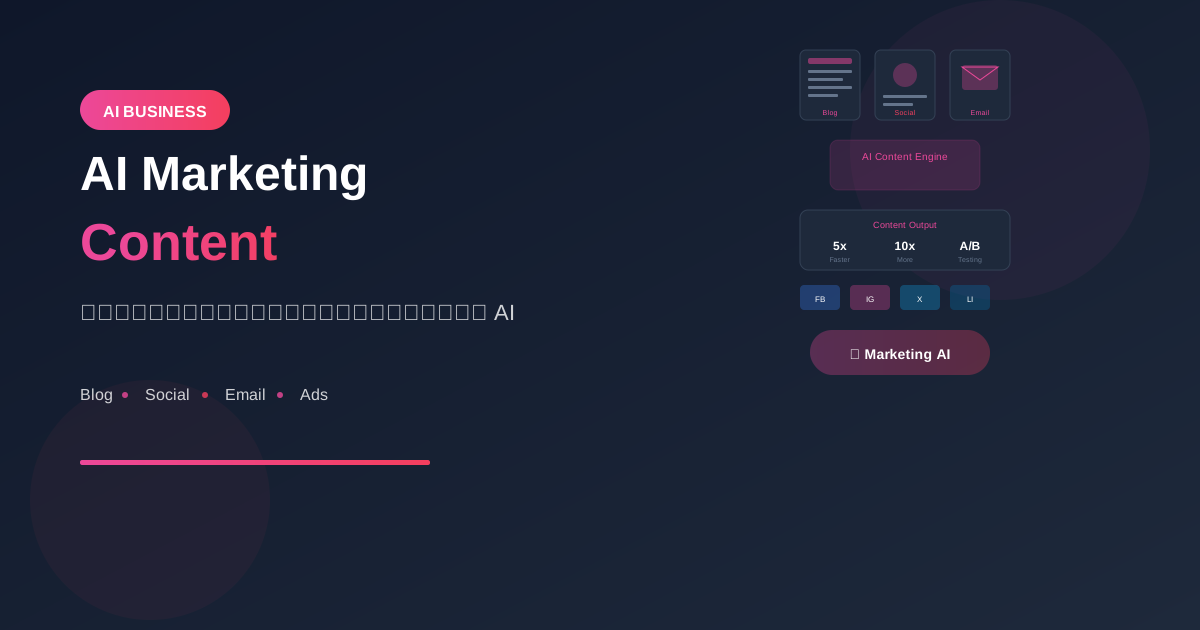
AI ช่วยให้ทีมการตลาดสร้างคอนเทนต์ได้เร็วขึ้น หลากหลายขึ้น และ personalized มากขึ้น
AI เปลี่ยนการทำ Marketing อย่างไร?
ก่อน vs หลังใช้ AI
Before AI:
- 1 blog post / week
- 2-3 social posts / day
- Generic content for all
- Copy-paste templates

After AI:
- 3-5 blog posts / week
- 10+ social posts / day
- Personalized content
- Dynamic, A/B tested copy
Content Types ที่ AI ช่วยได้
1. Blog Posts & Articles
2. Social Media Posts
3. Email Campaigns
4. Ad Copy (Google, Facebook)
5. Product Descriptions
6. Landing Pages
7. Video Scripts
8. Podcast Outlines
Blog Content Generation
Research & Outline
def generate_blog_outline(topic, target_audience, keywords):
    prompt = f"""
Create a comprehensive blog post outline about: {topic}

Target Audience: {target_audience}
SEO Keywords: {', '.join(keywords)}

Provide:
1. Compelling title options (3)
2. Meta description (160 chars)
3. H2 sections with H3 subsections
4. Key points for each section
5. Call-to-action suggestions
"""

    response = client.chat.completions.create(
        model="gpt-4o",
        messages=[{"role": "user", "content": prompt}]
    )

    return response.choices[0].message.content
Full Article Generation
def generate_blog_post(outline, style_guide, word_count=1500):
    prompt = f"""
Write a complete blog post based on this outline:
{outline}

Style Guide:
{style_guide}

Requirements:
- Word count: approximately {word_count}
- Include statistics and examples
- Use conversational but professional tone
- Add bullet points and numbered lists
- Include a strong introduction and conclusion
- Optimize for SEO naturally
"""

    response = client.chat.completions.create(
        model="gpt-4o",
        messages=[{"role": "user", "content": prompt}],
        max_tokens=3000
    )

    return response.choices[0].message.content
Social Media Content
Multi-Platform Generation
def generate_social_posts(topic, platforms, brand_voice):
    prompt = f"""
Create social media posts about: {topic}

Brand Voice: {brand_voice}

Generate posts for each platform:

1. Facebook (1-2 paragraphs, conversational)
2. Instagram (with emoji, hashtag suggestions)
3. Twitter/X (280 chars max, punchy)
4. LinkedIn (professional, thought leadership)
5. TikTok (script for 30-60 second video)

Include:
- Hook/opening line
- Main message
- Call-to-action
- Hashtag suggestions (where appropriate)
"""

    response = client.chat.completions.create(
        model="gpt-4o-mini",
        messages=[{"role": "user", "content": prompt}]
    )

    return response.choices[0].message.content
Content Calendar
def generate_content_calendar(month, themes, posting_frequency):
    prompt = f"""
Create a social media content calendar for {month}

Themes: {', '.join(themes)}
Posting Frequency: {posting_frequency}

For each day, provide:
- Platform
- Content type (image, video, story, carousel)
- Topic/Theme
- Caption idea
- Best posting time
- Hashtags

Format as a structured calendar.
"""

    response = client.chat.completions.create(
        model="gpt-4o",
        messages=[{"role": "user", "content": prompt}]
    )

    return response.choices[0].message.content
Email Marketing
Campaign Sequences
class EmailCampaignGenerator:
    def __init__(self, product_info, audience_segment):
        self.product = product_info
        self.audience = audience_segment

    def generate_welcome_sequence(self):
        emails = []

        sequence = [
            {"day": 0, "type": "welcome", "goal": "introduce brand"},
            {"day": 2, "type": "value", "goal": "share helpful content"},
            {"day": 5, "type": "social_proof", "goal": "build trust"},
            {"day": 7, "type": "soft_offer", "goal": "introduce product"},
            {"day": 10, "type": "offer", "goal": "convert"}
        ]

        for email in sequence:
            content = self._generate_email(email)
            emails.append(content)

        return emails

    def _generate_email(self, email_spec):
        prompt = f"""
Write an email for a welcome sequence.

Email Type: {email_spec['type']}
Goal: {email_spec['goal']}
Day in Sequence: {email_spec['day']}

Product: {self.product['name']}
Audience: {self.audience}

Provide:
1. Subject line (3 options with open rate prediction)
2. Preview text
3. Email body (conversational, under 300 words)
4. Call-to-action
"""

        response = client.chat.completions.create(
            model="gpt-4o-mini",
            messages=[{"role": "user", "content": prompt}]
        )

        return response.choices[0].message.content
Subject Line Optimization
def generate_subject_lines(email_content, audience):
    prompt = f"""
Generate 10 email subject lines for this email:

{email_content[:500]}

Target Audience: {audience}

For each subject line, provide:
- The subject line
- Type (curiosity, urgency, benefit, question, etc.)
- Predicted open rate (Low/Medium/High)

Focus on:
- Under 50 characters
- Mobile-friendly
- Avoiding spam triggers
- Creating curiosity or urgency
"""

    response = client.chat.completions.create(
        model="gpt-4o-mini",
        messages=[{"role": "user", "content": prompt}]
    )

    return response.choices[0].message.content
Ad Copy Generation
Google Ads
def generate_google_ads(product, keywords, landing_page):
    prompt = f"""
Create Google Ads for:

Product: {product['name']}
Features: {', '.join(product['features'])}
Keywords: {', '.join(keywords)}
Landing Page: {landing_page}

Generate 5 ad variations with:

Responsive Search Ads:
- 15 headlines (max 30 chars each)
- 4 descriptions (max 90 chars each)

For each variation:
- Different angle (benefit, feature, urgency, social proof)
- Include keywords naturally
- Strong call-to-action
"""

    response = client.chat.completions.create(
        model="gpt-4o",
        messages=[{"role": "user", "content": prompt}]
    )

    return response.choices[0].message.content
Facebook/Instagram Ads
def generate_facebook_ads(product, audience, objective):
    prompt = f"""
Create Facebook/Instagram ad copy for:

Product: {product['name']}
Target Audience: {audience}
Campaign Objective: {objective}

Generate 3 ad variations:

For each ad:
1. Primary Text (125 chars max for optimal display)
2. Headline (40 chars max)
3. Description (30 chars max)
4. Call-to-Action button suggestion
5. Ad format recommendation (image, video, carousel)
6. Suggested visual description

Angles to cover:
- Problem/Solution
- Social Proof/Results
- Scarcity/Urgency
"""

    response = client.chat.completions.create(
        model="gpt-4o-mini",
        messages=[{"role": "user", "content": prompt}]
    )

    return response.choices[0].message.content
Product Descriptions
E-commerce Copy
def generate_product_description(product_data, platform):
    prompt = f"""
Write a compelling product description for:

Product: {product_data['name']}
Category: {product_data['category']}
Features: {product_data['features']}
Price: {product_data['price']}
Target Customer: {product_data['target']}
Platform: {platform}

Provide:
1. Short description (50 words)
2. Long description (150-200 words)
3. Bullet points (5-7 key benefits)
4. SEO-optimized title
5. Meta description

Writing style:
- Focus on benefits, not just features
- Use sensory language
- Address customer pain points
- Create desire and urgency
"""

    response = client.chat.completions.create(
        model="gpt-4o-mini",
        messages=[{"role": "user", "content": prompt}]
    )

    return response.choices[0].message.content
Brand Voice Consistency
Style Guide Implementation
class BrandVoiceWriter:
    def __init__(self, brand_guidelines):
        self.guidelines = brand_guidelines
        self.system_prompt = self._create_system_prompt()

    def _create_system_prompt(self):
        return f"""
You are a copywriter for {self.guidelines['brand_name']}.

Brand Voice:
- Tone: {self.guidelines['tone']}
- Personality: {self.guidelines['personality']}
- Values: {', '.join(self.guidelines['values'])}

Writing Rules:
- {self.guidelines['dos']}
- Avoid: {self.guidelines['donts']}

Target Audience: {self.guidelines['audience']}

Always maintain brand consistency while adapting
to the specific platform and content type.
"""

    def write_content(self, content_type, topic, additional_context=""):
        prompt = f"""
Write {content_type} about: {topic}

{additional_context}

Ensure it matches our brand voice and guidelines.
"""

        response = client.chat.completions.create(
            model="gpt-4o-mini",
            messages=[
                {"role": "system", "content": self.system_prompt},
                {"role": "user", "content": prompt}
            ]
        )

        return response.choices[0].message.content
Content Optimization
A/B Testing Copy
def generate_ab_variants(original_copy, element_to_test):
    prompt = f"""
Create A/B test variants for this copy:

Original:
{original_copy}

Element to test: {element_to_test}

Generate 3 variants:
- Variant A: Different angle
- Variant B: Different emotional appeal
- Variant C: Different structure

For each variant, explain:
- What's different
- Hypothesis for why it might perform better
- Recommended test duration
"""

    response = client.chat.completions.create(
        model="gpt-4o",
        messages=[{"role": "user", "content": prompt}]
    )

    return response.choices[0].message.content
SEO Optimization
def optimize_content_for_seo(content, target_keywords):
    prompt = f"""
Optimize this content for SEO:

Content:
{content}

Target Keywords: {', '.join(target_keywords)}

Provide:
1. Optimized title tag (60 chars)
2. Meta description (160 chars)
3. Suggested H2/H3 headings with keywords
4. Internal linking suggestions
5. Image alt text suggestions
6. FAQ section for featured snippets
7. Content improvements for keyword density
"""

    response = client.chat.completions.create(
        model="gpt-4o",
        messages=[{"role": "user", "content": prompt}]
    )

    return response.choices[0].message.content
Workflow Integration
Content Pipeline
class ContentPipeline:
    def __init__(self, brand_voice, approval_workflow):
        self.brand = brand_voice
        self.workflow = approval_workflow

    def create_content_batch(self, content_requests):
        results = []

        for request in content_requests:
            # Generate content
            draft = self._generate_draft(request)

            # Quality check
            quality_score = self._check_quality(draft)

            # Brand voice check
            brand_aligned = self._check_brand_voice(draft)

            results.append({
                "request": request,
                "draft": draft,
                "quality_score": quality_score,
                "brand_aligned": brand_aligned,
                "status": "ready_for_review" if quality_score > 0.8 else "needs_revision"
            })

        return results

    def _check_quality(self, content):
        prompt = f"""
Rate this content quality (0-1):

{content}

Check for:
- Grammar and spelling
- Clarity and readability
- Engagement potential
- Call-to-action strength

Return only the score as a number.
"""

        response = client.chat.completions.create(
            model="gpt-4o-mini",
            messages=[{"role": "user", "content": prompt}]
        )

        return float(response.choices[0].message.content.strip())
Best Practices
1. Human Review Always
AI generates → Human reviews → Human approves

Never publish AI content without review:
- Check facts and claims
- Verify brand voice
- Add personal touches
- Ensure accuracy
2. Input Quality = Output Quality
Bad: "Write a blog post about marketing"
Good: "Write a 1500-word blog post about
      content marketing strategies for
      B2B SaaS companies targeting
      marketing managers, focusing on
      LinkedIn and email marketing"
3. Iterate and Improve
Track metrics:
- Engagement rates
- Conversion rates
- Time on page
- Share rates

Feed back into prompts:
"Our best performing posts have..."
"Our audience responds well to..."
สรุป
AI Marketing Content Benefits:
- Speed: สร้างคอนเทนต์เร็วขึ้น 5-10x
- Scale: ทำ personalization ได้มากขึ้น
- Consistency: รักษา brand voice ได้ดีขึ้น
- Testing: A/B test ได้มากขึ้น
- Cost: ลดต้นทุนต่อชิ้นคอนเทนต์
Key Applications:
- Blog posts & articles
- Social media content
- Email campaigns
- Ad copy
- Product descriptions
Remember:
- AI assists, humans finalize
- Quality over quantity
- Always review before publish
- Track and iterate
อ่านเพิ่มเติม:
เขียนโดย
AI Unlocked Team
สถาบันสอน AI และ Vibe Coding — เชียงใหม่และออนไลน์
AI Unlocked สอน AI และ Vibe Coding มากว่า 15 ปี ผู้เรียนกว่า 1,500 คน โฟกัสลงมือทำจริงด้วย Claude Code, n8n และ AI Agent
บทความในหัวข้อเดียวกัน
เรียน AI 2026 — Complete Roadmap จากศูนย์ถึงโปร
เรียน AI ปี 2026 ไม่รู้จะเริ่มต้นยังไง? อ่าน Roadmap ฉบับสมบูรณ์นี้ ครบทุก Stage พร้อม Track ตามอาชีพ เริ่มได้เลยวันนี้
28/05/2569
เรียน AI ใน 30 วัน — Plan สำหรับคนงานยุ่ง
เรียน AI 30 วัน ได้จริงไหม? Plan วันละ 1 ชม. สำหรับคนทำงานยุ่ง ตั้งแต่ Foundation ถึง Portfolio — เริ่มต้นได้เลยวันนี้ ดู Pricing
14/08/2569
เรียน AI แล้วเปลี่ยนสายงานได้จริงไหม — Real Case Thai
เรียน AI เปลี่ยนสายงานได้จริงในไทยปี 2026 — 4 case จริง timeline realistic และขั้นตอนที่ทำได้เลย เริ่มต้นที่ AI Unlocked
03/08/2569